Free Portfolio Tasks to Build Practical Skills and Prove Your Abilities (No Experience Required)
Table of Contents
Introduction
One of the biggest challenges facing graduates and people entering a new career is demonstrating that they can actually do the work.
You might have a university degree, completed several online courses, earned professional certificates or spent months learning a new skill. But when an employer asks what practical experience you have, explaining what you know is not always enough.
This creates a familiar problem: employers want experience, but getting that first opportunity to gain experience can be difficult.
A practical way to address this challenge is to build a portfolio of work that demonstrates your abilities.
Unlike a traditional CV, which primarily lists qualifications, employment history and skills, a portfolio gives potential employers something tangible to evaluate. It allows you to demonstrate how you approach problems, apply knowledge and produce work relevant to the position you want.
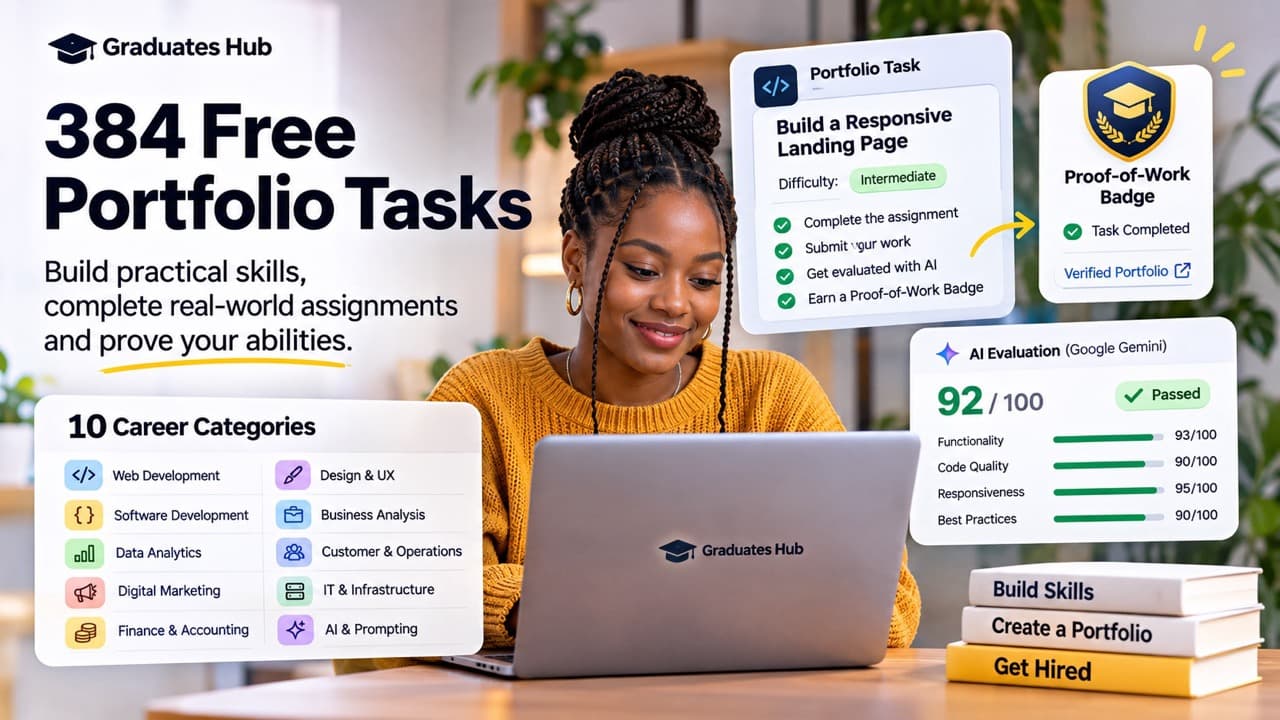
Graduates Hub offers a free Proof of Work Portfolio featuring practical tasks across 10 career categories. These assignments are designed to help graduates, students, aspiring professionals and career changers demonstrate their abilities through practical work rather than relying exclusively on qualifications.
Whether you are interested in software development, digital marketing, finance, business analysis, data analytics or artificial intelligence, there are tasks you can complete to start building evidence of your skills.
Here is what you can explore.
What Are Portfolio Tasks?
Portfolio tasks are practical assignments designed to demonstrate your ability to perform activities associated with a particular profession.
Instead of simply reading about a subject or completing a multiple-choice quiz, you are given a scenario or problem that requires you to apply your knowledge.
For example:
- Someone interested in digital marketing might be asked to develop a content strategy for a business.
- An aspiring data analyst might need to clean a dataset and identify meaningful business insights.
- A future software developer could be asked to design an API or troubleshoot an application.
- Someone pursuing business analysis might need to document business requirements and map an existing business process.
- An aspiring accountant might be asked to prepare a cash flow forecast for a small business.
These assignments help demonstrate how you approach problems and apply relevant professional skills.
The goal is to create evidence of your abilities that you can use when applying for internships, graduate programmes, entry-level positions or new career opportunities.
Explore 10 Categories of Free Portfolio Tasks on Graduates Hub
The Graduates Hub Proof of Work Portfolio includes 10 professional categories, each containing different topics and practical assignments.
Every topic offers three difficulty levels: Beginner, Intermediate and Advanced.
This means you can start with assignments appropriate to your current abilities and gradually challenge yourself with more demanding tasks.
Web Development Portfolio Tasks
If you are interested in becoming a web developer or frontend engineer, the Web Development category provides practical opportunities to demonstrate your technical abilities.
The assignments cover activities associated with building, improving and maintaining modern websites and web applications.
Some of the available topics include:
- Accessible Modal Dialogs
- API Data Fetching
- Authentication Flows
- Complex Multi-step Forms
- E-commerce Shopping Carts
- Full-Stack CRUD Applications
- Interactive Dashboard Layouts
- Landing Page Rebuilding
- Performance Optimisation
- Complex State Machines
For example, a landing page reconstruction assignment can test your ability to translate a visual reference into a functioning webpage using HTML, CSS and responsive design techniques.
Other assignments explore more advanced development concepts, including React state management, API integration, authentication and application performance.
These tasks can be particularly useful for aspiring frontend developers, full-stack developers and web development graduates who want to demonstrate practical skills beyond tutorial exercises.
Explore the Web Development Portfolio Tasks.
Software Development Portfolio Tasks
Software development requires more than knowing how to write code. Employers also look for people who can solve problems, design reliable systems, understand databases and produce maintainable software.
The Software Development category focuses on these practical engineering capabilities.
Available topics include:
- API Design
- Asynchronous Processing
- Authentication and Authorisation
- Backend Performance Optimisation
- CI/CD Pipeline Setup
- Code Refactoring
- Containerisation and Orchestration
- Database Modelling
- Debugging and Fixing Software
- Quality Assurance and Bug Reporting
For instance, an API design assignment challenges you to plan a REST API for a realistic scenario, including resource modelling and handling potential edge cases.
A debugging assignment tests your ability to identify a problem, understand its underlying cause, implement a solution and explain your reasoning.
These activities can help aspiring software engineers build evidence of their programming knowledge and problem-solving abilities.
Explore the Software Development Portfolio Tasks.
Data Analytics Portfolio Tasks
Data analytics is an increasingly important capability across industries. Businesses need professionals who can interpret information, identify patterns and turn data into useful decisions.
The Data Analytics category helps aspiring analysts demonstrate these abilities through practical assignments.
Topics include:
- Business Metrics and KPIs
- Dashboard Design and Business Intelligence Tools
- Data Cleaning and Insights
- Data Governance and Quality
- Data Storytelling and Presentation
- Data Visualisation
- ETL and Data Pipelines
- Machine Learning Fundamentals
- Python for Data Analysis
- Excel and Spreadsheet Modelling
For example, a data cleaning assignment requires you to work with an imperfect dataset, identify inconsistencies and transform the information into something useful.
Other assignments focus on building dashboards, choosing appropriate visualisations and explaining analytical findings to non-technical stakeholders.
These tasks are relevant to people pursuing careers as data analysts, business intelligence analysts, reporting analysts and junior data professionals.
Explore the Data Analytics Portfolio Tasks.
If you’re considering a career in data analytics, explore our data analyst career roadmap to understand the skills, tools and learning steps involved in entering the profession.
Digital Marketing Portfolio Tasks
Digital marketing is a broad profession that combines creativity, strategy, analytical thinking and technical knowledge.
However, simply stating that you understand SEO, social media marketing or paid advertising does not necessarily demonstrate that you can execute a marketing strategy.
The Digital Marketing category gives aspiring marketers opportunities to work through practical marketing scenarios.
Some of the available topics include:
- Brand Strategy and Positioning
- Content Strategy and Marketing
- Conversion Rate Optimisation
- Direct Response Copywriting and Ad Creative
- Email Experimentation
- Growth Strategy and Go-to-Market
- Influencer and Community Marketing
- Marketing Analytics and Attribution
- Marketing Automation and CRM
- App Store Optimisation and Mobile Growth
For example, a conversion rate optimisation assignment could involve analysing a landing page, identifying potential conversion barriers and proposing experiments to improve its performance.
A content strategy assignment can help demonstrate your ability to develop content briefs, organise topic clusters and connect content production to business objectives.
These assignments are particularly useful for aspiring SEO specialists, content marketers, social media managers, growth marketers and digital marketing professionals.
Explore the Digital Marketing Portfolio Tasks.
If SEO is your preferred specialisation, our SEO content strategist career roadmap provides further guidance on developing the skills required for this career.
Finance and Accounting Portfolio Tasks
Finance and accounting professionals are expected to understand financial information, interpret business performance and support sound financial decisions.
The Finance and Accounting category offers practical assignments built around realistic financial scenarios, including South African small and medium-sized business situations.
Available topics include:
- Audit and Internal Controls
- Budgeting and Variance Analysis
- Cash Flow Forecasting
- Corporate Finance and Capital Structure
- Financial Modelling and Valuation
- Financial Statements and Reporting
- Investment Appraisal
- Management Accounting
- Payroll and Statutory Returns
- Ratio Analysis
For example, a cash flow forecasting assignment requires you to develop a financial forecast based on assumptions and explain what the numbers mean for a business.
A ratio analysis assignment focuses on interpreting financial ratios and communicating what they reveal about an organisation’s financial position.
These tasks can help aspiring accountants, finance graduates, junior financial analysts and people interested in corporate finance demonstrate their understanding of practical financial concepts.
Explore the Finance and Accounting Portfolio Tasks.
Design and UX Portfolio Tasks
A career in user experience and product design requires more than creating visually appealing interfaces.
Design professionals must understand user behaviour, identify usability problems, organise information and develop solutions that balance user needs with business objectives.
The Design and UX category provides assignments that explore these capabilities.
Topics include:
- Accessibility and Inclusive Design
- Design Handoff and Developer Specifications
- Design Systems
- E-commerce UX and Checkout Optimisation
- Information Architecture
- Interaction Design and Micro-interactions
- Mobile UX and Mobile-first Design
- UI and Visual Design
- Usability Testing
- User Research and Interviews
For example, an information architecture assignment can involve organising website content into a logical structure and developing a navigation system that helps users find information.
A usability testing assignment can test your ability to develop a research plan, identify usability issues and interpret findings.
These assignments are suitable for aspiring UX designers, UI designers, product designers and user researchers.
Explore the Design and UX Portfolio Tasks.
Business Analysis Portfolio Tasks
Business analysts help organisations understand problems, define requirements and identify opportunities to improve processes and systems.
The Business Analysis category focuses on the documentation, analytical thinking and problem-solving skills required in these roles.
Available topics include:
- Agile Product Backlog Management and Refinement
- Business Case Development
- Change Management
- Data Modelling and Entity Relationship Diagrams
- Feasibility Studies
- Gap Analysis
- Interface Specifications and API Mapping
- Process Mapping and Improvement
- Project Coordination and Delivery
- Requirements Engineering
For example, a process mapping assignment might ask you to document how a business currently handles a particular process, identify bottlenecks and recommend improvements.
A business case assignment tests your ability to explain why an organisation should invest in a proposed solution, including costs, benefits and potential risks.
These tasks can be particularly useful for graduates interested in business analysis, systems analysis, product ownership and project coordination.
Explore the Business Analysis Portfolio Tasks.
Those interested in turning business problems into practical solutions can explore our business analyst career roadmap
Customer and Operations Portfolio Tasks
Customer support and business operations are sometimes overlooked when people discuss professional portfolios.
However, these roles involve important capabilities such as communication, problem-solving, process management, customer retention and operational reporting.
The Customer and Operations category provides practical assignments for people interested in these career paths.
Topics include:
- Churn Recovery and Customer Retention
- Helpdesk and CRM Configuration
- Customer Success and Onboarding
- Operational Compliance and Data Privacy
- Incident Management and Communication
- Knowledge Base Management
- Logistics and Dispatch Operations
- Operational Metrics and Reporting
- Policy Writing and Critique
- Quality Assurance and Ticket Review
For example, a customer retention assignment can involve identifying why customers are leaving a business and developing a strategy to improve retention.
A knowledge base management assignment tests your ability to create useful support documentation that helps customers resolve common problems.
These assignments can help aspiring customer success specialists, operations coordinators, customer support professionals and service delivery professionals demonstrate their capabilities.
Explore the Customer and Operations Portfolio Tasks.
IT and Infrastructure Portfolio Tasks
Information technology professionals are responsible for maintaining the systems, networks, devices and infrastructure that organisations depend on.
The IT and Infrastructure category focuses on practical activities associated with supporting and managing these environments.
Available topics include:
- IT Asset Management
- Backup and Disaster Recovery
- Cloud Fundamentals
- IT Compliance and Governance
- Cybersecurity Fundamentals
- Database Administration and Maintenance
- Endpoint and Device Management
- Identity and Access Management
- Microsoft 365 Administration
- Networking and Infrastructure
For instance, a cybersecurity assignment could involve identifying potential security weaknesses in a small organisation and developing an incident response plan.
A networking assignment might require you to plan a network configuration, work with subnetting and document troubleshooting procedures.
These tasks can help people pursuing careers in IT support, systems administration, network engineering, cybersecurity and cloud infrastructure.
Explore the IT and Infrastructure Portfolio Tasks.
AI and Prompting Portfolio Tasks
Artificial intelligence is changing how organisations approach research, communication, software development, automation and decision-making.
As AI tools become more common in professional environments, the ability to work with them effectively is becoming an increasingly useful skill.
The AI and Prompting category focuses on practical assignments involving prompt engineering, AI evaluation, automation and responsible AI usage.
Available topics include:
- Agent Flow Design
- AI Evaluation and Benchmarking
- Reasoning and Prompt Design
- Context Window Management
- Guardrails and Safety Prompting
- No-Code AI Automation and Workflow Design
- Output Formatting and Extraction
- Prompt Engineering Basics
- Prompt Security, Injection and Jailbreak Mitigation
- Prompting for Vector Databases and Semantic Search
For example, a prompt engineering assignment can challenge you to write structured prompts that produce consistent, useful outputs from an AI model.
An AI evaluation assignment goes further by testing whether a prompt consistently produces accurate results against defined evaluation criteria.
These activities are relevant to aspiring AI specialists, automation professionals, digital professionals and people who want to demonstrate practical AI literacy.
Explore the AI and Prompting Portfolio Tasks.
How Do the Graduates Hub Portfolio Tasks Work?
The platform is designed to make building a portfolio straightforward, even if you have never completed a professional portfolio project before.
You can get started in three steps.
Step 1: Choose a career category and topic
Visit the Graduates Hub Portfolio Tasks page and select the category that matches your career interests.
Browse the available topics and choose an assignment that aligns with the skills you want to demonstrate.
You do not need to select a category based on your university qualification alone. You can also explore tasks related to a career you want to transition into.
Step 2: Choose your difficulty level
Each topic provides three difficulty levels:
- Beginner: Suitable for people developing foundational knowledge and practical skills.
- Intermediate: Designed for people who already understand the fundamentals and want to demonstrate more developed capabilities.
- Advanced: Provides more challenging scenarios that require deeper analysis, technical knowledge and problem-solving.
Starting at the beginner level is perfectly reasonable if you are new to a particular field.
You can work through progressively more challenging assignments as your skills improve.
Step 3: Complete the assignment and earn a Proof-of-Work Badge
Once you select a task, follow the assignment brief and prepare your submission.
Your work is evaluated using AI against a published assessment rubric.
The rubric makes the assessment criteria visible before you submit, helping you understand what the assignment expects and how your work will be evaluated.
If your submission meets the required passing criteria, you earn a shareable Proof-of-Work Badge.
The badge has a unique public URL that displays your name, the completed assignment, your submission, rubric scores and an evaluation summary.
The platform also discloses that the submissions are reviewed using Google Gemini AI, rather than presenting the evaluation as human assessment.
You can share your badge through LinkedIn, include it in your CV or reference it when applying for relevant opportunities.
Why Should You Build a Portfolio If You Already Have a CV?
A CV and a portfolio serve different purposes.
Your CV communicates your professional background, qualifications, experience and skills. Your portfolio provides supporting evidence of what you can actually produce.
Consider two graduates applying for an entry-level digital marketing position.
The first graduate lists SEO, content marketing, keyword research and analytics as skills on their CV.
The second graduate lists the same skills but also includes a practical SEO audit, a keyword research exercise and a content strategy assignment.
The second applicant has something additional to discuss during an interview.
They can explain how they approached a problem, what they discovered, why they made particular recommendations and how they would implement their proposed solution.
This does not automatically make them a better candidate, but it gives an employer more information with which to evaluate their capabilities.
A portfolio can help you:
1. Demonstrate practical skills
Show that you can apply what you have learned rather than simply repeat theoretical information.
2. Strengthen your CV and LinkedIn profile
Include relevant portfolio links when describing your skills and professional development.
3. Prepare for technical interviews and assessments
Many portfolio assignments resemble the types of problems candidates encounter during recruitment processes.
4. Identify your skills gaps
Assessment feedback can help you understand which areas need improvement.
5. Build confidence when applying for opportunities
Having completed practical assignments gives you examples to discuss when employers ask about your experience.
Can You Build a Portfolio Without Professional Work Experience?
Yes.
You do not necessarily need a previous employer, internship or paying client to start building a portfolio.
You can develop practical work independently through structured assignments, personal projects, simulations and case studies.
The important distinction is that you should be transparent about where your experience comes from.
If you completed a simulated business analysis assignment, describe it as a portfolio project rather than claiming that you delivered the work for an actual organisation.
Employers are interested in understanding your capabilities, but they also need accurate information about your experience.
A well-documented independent project can still demonstrate problem-solving, technical knowledge, communication and initiative.
This is particularly relevant for:
- University graduates who have not yet secured their first job.
- Students who want to develop practical experience before graduating.
- Job seekers who want to strengthen their applications.
- Career changers entering a different professional field.
- Self-taught professionals who want to demonstrate their abilities.
- Professionals looking to expand their existing skill sets.
Tips for Getting the Most Out of Your Portfolio Tasks
Completing assignments is a good starting point, but the way you approach them can make a significant difference to the quality of your portfolio.
Here are some practical recommendations.
Choose tasks that align with your career goals.
Avoid completing random assignments simply to accumulate badges. Prioritise work that demonstrates skills relevant to the positions you want.
Focus on quality rather than quantity.
A small collection of well-executed projects is generally more useful than dozens of incomplete or poorly documented assignments.
Understand the assessment rubric.
Review the evaluation criteria before starting. Use them to guide your approach and check your work before submission.
Explain your thinking.
Where appropriate, document the problem, your approach, the decisions you made and the reasoning behind your solution.
Build progressively.
Start with beginner assignments if necessary. Use the feedback to identify weaknesses before attempting intermediate and advanced tasks.
Share relevant evidence with employers.
Add your strongest work and relevant badge links to your LinkedIn profile, online portfolio and job applications.
Be honest about your work.
Clearly distinguish between independent projects, simulated assignments, academic work and professional client experience.
Start Building Your Professional Portfolio for Free
Getting your first professional opportunity can be challenging when you have limited work experience.
However, you do not have to wait until an employer gives you an opportunity to start demonstrating your abilities.
You can begin by identifying the skills required in your chosen profession, completing practical assignments and building a collection of work that demonstrates what you can do.
The Graduates Hub Proof of Work Portfolio provides a starting point with 384 practical tasks across 10 professional categories, covering everything from web development and finance to business analysis, digital marketing and artificial intelligence.
The assignments offer three difficulty levels, published assessment rubrics and the opportunity to earn shareable Proof-of-Work Badges.
Best of all, the portfolio tasks, submissions, evaluations and badges are free. You do not need to purchase a course, pay for an assessment or have an existing professional portfolio to get started.
Whether you are a recent graduate, a student, an unemployed job seeker or someone considering a career change, you can start developing practical evidence of your abilities today.
Explore the free Graduates Hub Portfolio Tasks and start building a portfolio that demonstrates what you can do.

Written by
Jason
Jason is a Web Technology Specialist specializing in SEO and content-driven digital platforms. He is the founder of GraduatesHub.co.za, where he publishes research-backed guides on free online courses, career development, and in-demand skills. In addition to GraduatesHub, Jason has worked on multiple SEO-focused web projects, gaining hands-on experience in content strategy, search optimization, and scaling organic traffic. His work centers on analysing online learning platforms such as Alison and Coursera, and helping users identify practical, career-relevant opportunities. His insights are based on direct platform testing, market research, and continuous monitoring of digital education trends.
Build Your Proof of Work Portfolio
Put reading into practice: complete graded portfolio tasks across IT, Web Dev, Data Analysis, Marketing, and Finance.
Not sure what to do with these courses?
Use our free AI career tools to review your CV, prep for interviews, identify skill gaps, and build a personalised learning roadmap.
Related Articles
Oct 25, 2026
Free CDC and NIH Public Health Certificates for Healthcare and NGO Workers (2026 Guide)
Discover how to earn free public health certificates, CEUs, and bioethics credentials from the CDC and NIH in 2026. Perf...
Read Article →
Oct 25, 2026
SBA Learning Center vs. FAI: Free Government Business and Contracting Courses (2026/27)
Compare free business, finance, and government contracting courses with certificates from the U.S. Small Business Admini...
Read Article →
Oct 25, 2026
CISA Learning (Formerly FedVTE): Free Government Cybersecurity Training Guide (2026)
Learn how to access free government cybersecurity courses and certificates on CISA Learning (formerly FedVTE) in 2026. E...
Read Article →