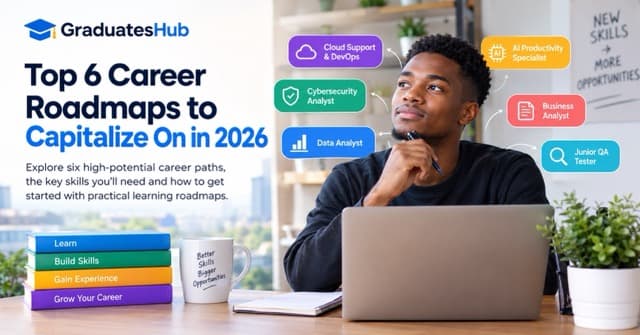
Top 6 Career Roadmaps to Capitalize On in 2026
Table of Contents
The traditional approach to building a career is changing. A university qualification is no longer the only route into certain technology and business professions. Employers are increasingly looking for candidates who can demonstrate practical skills, understand industry tools and apply their knowledge to real-world problems.
According to the World Economic Forum’s Future of Jobs Report 2025, technological developments, artificial intelligence, cybersecurity and digital transformation are expected to reshape the global employment landscape by 2030. The report estimates that 170 million new jobs could be created, while 92 million existing jobs could be displaced, resulting in a net increase of 78 million jobs.
For graduates, job seekers and people considering a career change, this creates an opportunity to look beyond traditional career choices and develop skills aligned with changing business needs.
At Graduates Hub, our Career Roadmaps provide structured learning paths for individuals who want to enter technology, business, marketing and other professional fields. These roadmaps combine foundational learning, practical tools, portfolio projects and interview preparation.
Here are six career paths worth exploring in 2026, particularly for individuals looking to develop practical, employable skills without necessarily pursuing another university degree.
1. AI Productivity Specialist
Artificial intelligence is changing how businesses approach everyday operations, from administrative work and research to marketing and data analysis. However, using AI tools effectively requires more than knowing how to write a few prompts.
An AI Productivity Specialist focuses on identifying opportunities to integrate AI into business workflows, automate repetitive activities and improve operational efficiency.
This career path is particularly interesting because it combines technology with business problem-solving. You do not necessarily need an advanced programming background to get started.
Skills worth developing:
- Generative AI fundamentals and large language models.
- Prompt engineering and structured instructions.
- Google Gemini and ChatGPT workplace integration.
- AI-assisted research, reporting and data analysis.
- Workflow automation and responsible AI practices.
How to get started: Graduates Hub’s AI Productivity Specialist Career Roadmap provides a five-stage learning path estimated at one to three months. It includes Google AI Essentials and practical portfolio projects, such as building reusable prompt libraries and automated research workflows.
This is worth considering if you enjoy experimenting with technology and finding ways to make business processes more efficient.
2. Cybersecurity Analyst
As organisations become increasingly dependent on digital infrastructure, protecting networks, applications and sensitive information remains an important business responsibility.
Cybersecurity analysts help organisations identify vulnerabilities, monitor suspicious activity, investigate security incidents and maintain security controls.
The World Economic Forum identifies networks and cybersecurity among the fastest-growing skills expected between 2025 and 2030. This makes cybersecurity an area worth investigating for people interested in technical problem-solving and information security.
Skills worth developing:
- Computer networking, TCP/IP and DNS.
- Linux and operating system fundamentals.
- Security monitoring and SIEM tools.
- Vulnerability assessments and threat analysis.
- Security frameworks, including NIST and ISO 27001.
How to get started: The Cybersecurity Analyst Career Roadmap on Graduates Hub provides a five-stage learning path estimated at six to twelve months.
It covers networking fundamentals, security governance, regulatory compliance and practical security testing. Learners also work towards portfolio projects, including simulated vulnerability assessments and incident response reports.
This path is particularly suitable for people who enjoy investigating technical problems, working with systems and understanding how organisations protect their digital assets.
3. Cloud Support and DevOps Engineer
Modern businesses rely on cloud infrastructure to host applications, store information and deliver digital services. Managing these environments requires professionals who understand infrastructure, deployment processes and system reliability.
Cloud Support and DevOps Engineers work across development and IT operations. Their responsibilities can include managing cloud environments, troubleshooting infrastructure issues, automating deployment processes and monitoring application performance.
The World Economic Forum’s 2025 report includes DevOps Engineers among the fastest-growing job categories identified in its employer survey.
Skills worth developing:
- Cloud computing fundamentals.
- AWS and Microsoft Azure.
- Linux command-line operations.
- Docker and containerisation.
- CI/CD pipelines and deployment automation.
- Infrastructure monitoring and troubleshooting.
How to get started: Graduates Hub’s Cloud Support and DevOps Engineer Career Roadmap offers a structured learning path estimated at six to twelve months.
The roadmap focuses on developing practical infrastructure knowledge and understanding the tools used to deploy and maintain applications.
For individuals interested in technical IT careers, this is an opportunity to move beyond traditional IT support and develop infrastructure and automation skills.
4. Business Analyst
Not every promising career opportunity requires becoming a software developer or cybersecurity specialist.
Business analysts play an important role in helping organisations understand problems, improve processes and identify suitable technology solutions.
They work between business stakeholders and technical teams, translating business requirements into actionable recommendations. Depending on the organisation, their work may involve analysing processes, documenting requirements, evaluating systems and supporting digital transformation projects.
This career is particularly interesting for people who have experience in administration, operations, finance, IT or other business environments.
Skills worth developing:
- Business requirements gathering.
- Process mapping and documentation.
- Microsoft Excel and data analysis.
- SQL fundamentals.
- Agile and Scrum methodologies.
- Business process modelling.
How to get started: The Business Analyst Career Roadmap from Graduates Hub provides a four-stage learning path estimated at six to ten months.
It introduces learners to business analysis fundamentals, technical tools and practical projects that demonstrate their ability to investigate and solve business problems.
A particularly useful advantage of this career path is that professionals from different industries can potentially transfer their existing industry knowledge into business analysis.
5. Junior QA Tester
Software development involves more than writing code. Before applications and websites reach users, they need to be tested to identify defects, usability problems and unexpected behaviour.
Junior Quality Assurance (QA) Testers help ensure that software products work as intended. They execute test cases, document bugs, verify fixes and communicate issues to development teams.
This can be an accessible starting point for individuals interested in software development but who are not yet confident in programming.
Skills worth developing:
- Software testing fundamentals.
- Manual testing techniques.
- Writing and executing test cases.
- Bug reporting and documentation.
- Regression and functional testing.
- Introduction to automated testing.
How to get started: Graduates Hub’s Junior QA Tester Career Roadmap offers a five-stage learning path estimated at three to six months.
The roadmap introduces software testing concepts and practical exercises designed to help learners demonstrate their understanding of quality assurance.
For someone entering the technology industry, QA testing offers an alternative route into software teams without making advanced programming knowledge an initial requirement.
6. Data Analyst
Businesses collect large amounts of information, but raw data has limited value unless someone can interpret it and turn it into useful insights.
Data analysts help organisations understand performance, identify patterns and make informed decisions. They work with datasets, spreadsheets, databases and visualisation tools to communicate findings.
The World Economic Forum identifies Big Data Specialists and Data Analysts and Scientists among the fastest-growing job categories in its 2025 employment outlook.
Skills worth developing:
- Microsoft Excel and spreadsheet analysis.
- SQL and database querying.
- Python fundamentals.
- Power BI or Tableau.
- Data cleaning and visualisation.
- Statistical and analytical thinking.
How to get started: The Data Analyst Career Roadmap on Graduates Hub provides a five-stage learning path estimated at six to twelve months.
It takes learners from foundational data concepts to technical tools and practical portfolio projects.
This is a particularly useful career option for people who enjoy working with numbers, identifying patterns and solving problems using evidence.
How to Choose the Right Career Roadmap in 2026
Choosing a career based solely on salary expectations or online discussions about which profession is in demand can lead to poor decisions.
Instead, consider three important factors:
1. Your existing strengths: If you enjoy working with numbers, data analysis may be a natural starting point. If you prefer investigating technical problems, cybersecurity or QA testing could be worth exploring.
2. The skills employers require: Research actual job advertisements for your target position. Identify recurring tools, qualifications and technical requirements, then compare them against the skills covered in your chosen roadmap.
3. Your ability to demonstrate practical experience: Completing online courses is a useful starting point, but certificates alone do not demonstrate that you can perform a job. Build projects, document your work and create a portfolio that prospective employers can evaluate.
Graduates Hub follows a structured four-stage learning framework: core fundamentals, technical tool mastery, proof of work and interview preparation. The aim is to help learners progress beyond watching tutorials and towards demonstrating practical competence.
Final Thoughts
The career opportunities worth exploring in 2026 extend beyond traditional graduate programmes and conventional university pathways. Artificial intelligence, cybersecurity, cloud infrastructure, business analysis, software testing and data analytics all offer different routes into professional work.
However, completing a career roadmap does not guarantee employment. Hiring requirements vary between employers, and learners must still demonstrate their capabilities through relevant projects, technical assessments and interviews.
The most effective approach is to choose one career direction, develop the required skills consistently and build evidence of what you can do.
Ready to start? Explore all the Graduates Hub Career Roadmaps and find a structured learning path that matches your career goals.

Written by
Jason
Jason is a Web Technology Specialist specializing in SEO and content-driven digital platforms. He is the founder of GraduatesHub.co.za, where he publishes research-backed guides on free online courses, career development, and in-demand skills. In addition to GraduatesHub, Jason has worked on multiple SEO-focused web projects, gaining hands-on experience in content strategy, search optimization, and scaling organic traffic. His work centers on analysing online learning platforms such as Alison and Coursera, and helping users identify practical, career-relevant opportunities. His insights are based on direct platform testing, market research, and continuous monitoring of digital education trends.
Not sure what to do with these courses?
Use our free AI career tools to review your CV, prep for interviews, identify skill gaps, and build a personalised learning roadmap.
Related Articles

Oct 4, 2026
How to Become an SEO Content Strategist in 2026: What the Job Really Requires
SEO in 2026 is about far more than keywords and rankings. Learn what it really takes to become an SEO Content Strategist...
Read Article →
Aug 7, 2026
Understanding the YES Youth Program: Industries, Facilitators, and Certificate Value
A comprehensive breakdown of South Africa’s YES Youth program. Discover how the 12-month initiative works across top ind...
Read Article →
Jul 26, 2026
Is an Alison Certificate Recognised by Employers in 2026? (Honest Review)
Will hiring managers take your Alison certificate seriously in 2026? Here is an honest review of Alison CPD accreditatio...
Read Article →