What Is Dropshipping? How It Works, Benefits, Costs and How to Get Started
Starting an online store traditionally required renting warehouse space, buying bulk stock upfront, and taking on significant financial risk before making a single sale. Dropshipping removes those barriers by shifting inventory storage and order fulfilment to third-party suppliers.
However, despite what viral social media posts suggest, dropshipping is not a passive “get-rich-quick” shortcut. It is a competitive retail model that requires careful supplier vetting, sharp marketing, and disciplined financial management.
In this guide, you will learn exactly what dropshipping is, how the fulfilment and money flows work, the real startup costs, and the practical steps to launch a compliant dropshipping business, including specific considerations for entrepreneurs in South Africa.
What Is Dropshipping?
Dropshipping is an ecommerce business model where a retailer sells products online without keeping inventory. When a customer places an order, the retailer purchases the product from a third-party supplier, who packages and ships it directly to the customer. The retailer earns money from the difference between the selling price and business costs.
Whether you spell it dropshipping or drop shipping, the core concept remains the same: you act as the customer-facing storefront, marketer, and customer service point, while a manufacturer, wholesaler, or fulfilment partner handles the physical goods.
Traditional Retail vs. Dropshipping
Understanding the dropshipping meaning becomes much clearer when you compare it directly to conventional ecommerce:
| Feature | Traditional Ecommerce Retail | Dropshipping Business Model |
| Inventory Ownership | Retailer buys stock upfront in bulk. | Retailer buys stock only after a customer pays. |
| Storage & Warehousing | Retailer stores products in a home, office, or warehouse. | Supplier stores and manages all physical inventory. |
| Order Fulfilment | Retailer packs and ships every parcel. | Supplier picks, packs, and ships directly to the buyer. |
| Upfront Capital Risk | High risk of unsold inventory sitting on shelves. | Low upfront stock risk; capital goes toward marketing and store setup. |
| Profit Margins | Higher per-unit margins due to wholesale bulk discounts. | Lower per-unit margins due to single-unit supplier pricing. |
How Does Dropshipping Work?
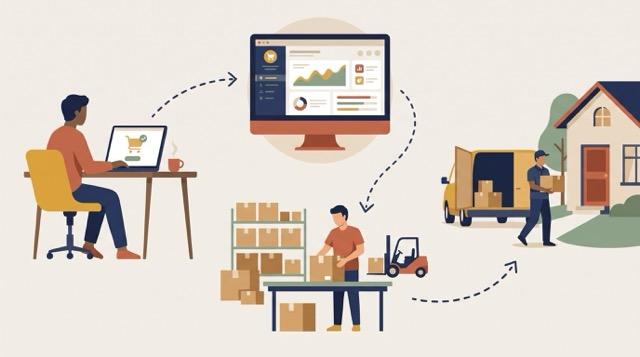
At a glance, the dropshipping process follows five straightforward steps from checkout to delivery:
- A customer purchases a product from an online store.
- The store owner receives the payment.
- The order is forwarded to a supplier.
- The supplier packages and ships the product.
- The store owner earns the remaining margin after expenses.
[ Customer ]  --(1. Places Order & Pays Retail Price)-->  [ Your Online Store ]
     ^                                                            |
     |                                            (2. Forwards Order & Pays Wholesale)
     |                                                            v
[ Courier ]   <--(3. Hands Over Packaged Parcel)---------  [ Third-Party Supplier ]
     |
     +-----------(4. Delivers Direct to Customer's Door)----------+
Here is what happens behind the scenes at each stage of the order lifecycle:
A Customer Places an Order
A shopper visits your online store, adds an item to their cart, and completes checkout at your retail price (for example, R500). They receive an automated order confirmation from your brand and generally do not know that a third-party supplier is involved behind the scenes.
The Store Owner Sends the Order to the Supplier
Once payment clears in your payment gateway, you forward the order details and the customer’s shipping address to your supplier. Depending on your setup, you can do this manually via email or a supplier portal, or automatically using dropshipping software that syncs your store with the supplier’s inventory system. At this stage, you pay the supplier their wholesale price plus any applicable shipping fee.
The Supplier Ships the Product
Your supplier picks the item from their warehouse, packages it, and dispatches it via a courier service directly to your customer’s address. Reputable dropshipping suppliers offer blind shipping—meaning they ship parcels without their own promotional flyers or wholesale invoices inside, so the customer experiences a seamless delivery from your store.
The Store Owner Makes a Profit
Your gross profit is the difference between what the customer paid you and what you paid the supplier. However, your true net profit—how dropshippers actually make money—is what remains after you subtract payment gateway fees, ecommerce platform subscriptions, advertising spend, and any return or refund costs.
What Are the Benefits of Dropshipping?
For aspiring entrepreneurs, students, and young professionals exploring self-employment, the advantages of dropshipping solve several major hurdles of starting a retail company.
Low Initial Investment
Traditional retail often demands tens of thousands of rands in initial inventory before you validate whether anyone actually wants your product. With dropshipping, you do not tie up cash in stock that might never sell. Your primary startup costs go toward building a clean website, registering a domain, and testing marketing campaigns.
No Need to Store Inventory
Because your supplier holds the stock, you do not need a spare garage, storage unit, or warehouse staff. You also avoid the operational headaches of tracking shelf life, managing seasonal overstock, or physically packing boxes late at night.
Flexible Business Operations
A dropshipping store can be managed from anywhere with a reliable internet connection and a laptop. Furthermore, scaling up is operationally simpler than in traditional retail: if a marketing campaign suddenly brings in 100 orders in a weekend, your suppliers absorb the physical fulfilment workload rather than leaving you overwhelmed by manual packing.
What Are the Disadvantages of Dropshipping?
Every legitimate business model involves trade-offs. Ignoring the disadvantages of dropshipping is the main reason beginners lose money in their first few months.
Lower Profit Margins
Because you are buying items one unit at a time rather than in bulk containers, suppliers charge you higher per-unit prices. Combined with rising digital advertising costs and intense competition in popular niches, net profit margins in dropshipping commonly sit between 10% and 20%.
Dependence on Suppliers
Your brand reputation rests entirely in the hands of a third party. If a supplier runs out of stock without updating their feed, ships a defective item, or sends the wrong colour, your customer blames your store—not the warehouse.
Shipping and Delivery Challenges
Working with multiple suppliers means a single customer order containing three different items might arrive in three separate packages on different days, multiplying your shipping fees. If you rely on overseas suppliers, long transit times can also lead to impatient customers and high refund requests.
Customer Service Responsibilities
Even though you never touch the physical product, you are legally and commercially responsible for the customer experience. You must handle tracking enquiries, damaged-in-transit claims, returns, and chargebacks promptly.
How Much Does It Cost to Start Dropshipping?
While you can technically launch a basic storefront on a shoestring budget, running a sustainable dropshipping store requires realistic working capital. Below is an estimated breakdown of typical startup and monthly operating expenses for a beginner store in South Africa:
| Expense Category | Estimated Cost (ZAR) | Frequency | Notes |
| Domain Name (.co.za or .com) | R100 – R250 | Annual | Custom domain builds trust with shoppers. |
| Ecommerce Platform | R450 – R750 | Monthly | Basic plans on platforms like Shopify or web hosting for WooCommerce. |
| Supplier Apps & Automation | R0 – R500 | Monthly | Many supplier directories have free starter tiers; automation scales with order volume. |
| Product Samples | R500 – R1,500 | One-off | Essential for checking product quality and delivery speed before advertising. |
| Marketing & Ad Testing | R2,000 – R5,000+ | Monthly | Paid ads (Meta, TikTok, Google) or content creation to drive initial traffic. |
| Payment Gateway Fees | ~2.9% – 3.5% + R2 | Per transaction | Deducted automatically per sale by local payment processors. |
Total Realistic Starting Budget: Plan for roughly R3,500 to R8,000 to cover your first two to three months of store setup, sample orders, and initial marketing tests without running out of cash before gathering data.
How to Start a Dropshipping Business
Follow these six practical steps to move from an idea to a functioning online store.
1. Choose a Profitable Niche
Avoid general stores that sell random trending gadgets—they struggle to build trust and face fierce price competition. Instead, choose a focused niche where customers have specific problems or passions (such as ergonomic home-office accessories, eco-friendly pet supplies, or specialty coffee gear).
Look for products priced high enough to leave room for ad spend, yet lightweight and durable enough to ship affordably without breaking.
2. Find Reliable Suppliers
Your supplier is your most important business partner. Look for suppliers who offer:
- Clear wholesale pricing and transparent shipping rates.
- Real-time inventory tracking so you do not sell out-of-stock items.
- Clear return and damaged-goods policies.
- Fast dispatch times (ideally within 24 to 48 hours).
Always order samples of your top products to inspect the packaging, build quality, and actual delivery speed firsthand.
3. Choose an Ecommerce Platform
Two platforms dominate the beginner dropshipping space:
- Shopify: A hosted, all-in-one platform built specifically for ecommerce. It handles security, hosting, and checkout seamlessly and integrates directly with major dropshipping apps, making it ideal for beginners who want minimal technical maintenance.
- WooCommerce: A free, open-source plugin for WordPress. It gives you complete control over customization and avoids monthly platform fees, though you must manage your own web hosting, security updates, and plugins.
4. Add Products to Your Online Store
Do not copy and paste generic manufacturer descriptions, which often contain awkward phrasing and hurt your search engine visibility. Write clear, benefit-driven product descriptions that answer common buyer questions (dimensions, materials, care instructions, and delivery timelines).
Use crisp, high-resolution images and set retail prices that cover your product cost, shipping, gateway fees, and marketing expenses.
5. Set Up Payments and Delivery
Configure a trusted payment gateway so customers can pay using familiar methods like debit/credit cards, instant EFT, or digital wallets. Set up clear shipping zones and flat-rate or free-shipping thresholds on your checkout page, and publish transparent Shipping, Refund, and Privacy policies in your store footer.
6. Market Your Dropshipping Business
A live website will not generate sales on its own. Build a balanced acquisition strategy using:
- Paid Advertising: Meta (Facebook and Instagram), TikTok, and Google Shopping ads allow you to test product demand quickly with controlled daily budgets.
- Organic Social Media: Short-form product demonstrations, unboxing clips, and problem-solving videos on TikTok and Instagram Reels can generate free traffic over time.
- Search Engine Optimization (SEO): Publishing helpful buying guides and optimizing category pages helps your store attract high-intent shoppers searching on Google.
Is Dropshipping Profitable in 2026?
Yes, dropshipping can be profitable in 2026, provided you treat it as a real retail brand rather than a passive side hustle. Profitability depends directly on your product margins, customer acquisition costs, supplier reliability, and ability to differentiate your store.
In recent years, rising digital advertising costs and consumers’ growing expectations for fast shipping have squeezed out low-effort stores selling cheap, generic imports. Stores that remain profitable focus on:
- Higher-ticket or repeat-purchase niches where a single sale generates enough margin to cover ad costs.
- Local or regional suppliers that deliver within days rather than weeks.
- Strong branding and customer service that turn one-time buyers into repeat customers.
Hypothetical South African Profit Example (R500 Sale)
To see how the numbers work in practice, consider a realistic breakdown of selling a single R500 product through a South African dropshipping store:
- Customer Retail Price: R500.00
- Supplier Product Cost: – R210.00
- Local Courier Delivery Fee: – R75.00
- Payment Gateway Fee (e.g., ~3.2% + R2): – R18.00
- Allocated Advertising Cost per Sale (CPA): – R115.00
- Net Profit per Order: R82.00 (16.4% net margin)
If you sell 50 units in a month at that margin, you generate R4,100 in net profit before fixed monthly software fees (such as your Shopify subscription). Improving your website conversion rate or bundling complementary items to raise average order value is how experienced dropshippers widen that margin.
How Does Dropshipping Work in South Africa?
Running a dropshipping business in South Africa comes with distinct logistical, payment, and regulatory realities that international guides often overlook.
Local vs. International Suppliers
You have two primary sourcing routes in South Africa:
- Local South African Dropshipping Suppliers: Companies and wholesalers based in hubs like Johannesburg, Cape Town, or Durban hold stock locally and dispatch via domestic couriers (such as The Courier Guy, RAM, or Pargo). Delivery typically takes 1 to 4 business days, returns are simple, and customers avoid surprise customs bills.
- International Suppliers (e.g., AliExpress, CJdropshipping, Print-on-Demand networks): Overseas suppliers offer massive product variety, but shipping to South Africa can take 2 to 5 weeks depending on customs clearance. Furthermore, imported parcels are subject to SARS customs duties and 15% import VAT, which can cause customers to reject parcels at delivery if not clearly disclosed upfront.
Ecommerce Platforms & Local Marketplaces
Both Shopify and WooCommerce work smoothly in South Africa and support ZAR pricing and local payment integrations.
Keep in mind that third-party South African marketplaces—such as Takealot or Makro Marketplace—generally enforce strict Service Level Agreements (SLAs) requiring fast dispatch times, specific barcoding, or stock held in their own distribution centres. As a result, traditional dropshipping from overseas or slow third-party suppliers rarely works on local marketplaces; building your own independent online store is the safer route.
South African Payment Solutions
South African shoppers expect familiar, secure local checkout options rather than US-centric gateways. Popular integrations include:
- PayFast: Supports credit/debit cards, Instant EFT, SnapScan, Zapper, and store cards.
- Yoco: Offers straightforward online card payment plugins for Shopify and WooCommerce with transparent local transaction rates.
- Ozow: Specializes in automated Instant EFT payments directly from major South African banks.
Legal, Tax, and Consumer Compliance
Before scaling your store, make sure you understand the basic compliance framework in South Africa (note: this is general educational information—consult a registered accountant or legal practitioner for advice tailored to your business):
- Business Registration: You can start trading as a sole proprietor in your personal capacity, or register a Private Company (Pty) Ltd through the Companies and Intellectual Property Commission (CIPC) to separate personal and business liability.
- Income Tax & VAT: All business profits must be declared to the South African Revenue Service (SARS), even if you operate as a sole proprietor. Compulsory VAT registration applies once your taxable turnover exceeds R1 million in any consecutive 12-month period, though voluntary registration is available below that threshold if you meet SARS criteria.
- Consumer Protection Act (CPA) & ECTA: Under South African consumer law and the Electronic Communications and Transactions Act (ECTA), online shoppers have specific cooling-off rights, rights to clear product descriptions and total pricing (including delivery and taxes), and protections against defective goods—even if a third-party supplier fulfilled the order.
Beginner Dropshipping Launch Checklist
Use this practical checklist before spending money on ads:
- [ ] Niche Validated: Selected a focused product category with clear buyer demand and healthy retail margins.
- [ ] Suppliers Vetted: Confirmed stock availability, blind-shipping capability, return terms, and dispatch times.
- [ ] Samples Ordered: Inspected physical product quality and real courier transit times firsthand.
- [ ] Storefront Built: Configured a clean, mobile-friendly store on Shopify or WooCommerce with a custom domain.
- [ ] Policies Published: Added clear Shipping, Returns & Refunds, Privacy Policy, and Terms of Service pages.
- [ ] Payments Tested: Connected a South African payment gateway (such as PayFast, Yoco, or Ozow) and ran a live test transaction.
- [ ] Unit Economics Calculated: Verified that your retail price covers product cost, shipping, gateway fees, and realistic ad spend.
Frequently Asked Questions About Dropshipping
1. What is dropshipping in simple terms?
Dropshipping is an online retail method where you run an online store without holding any stock. When someone buys a product from your website, you order that item from a third-party supplier, and the supplier ships it straight to your customer.
2. How does dropshipping work for beginners?
Beginners set up an online store, list products from vetted suppliers at a retail markup, and promote the store online. Whenever an order comes in, the store owner pays the supplier’s wholesale price, submits the buyer’s delivery address, and keeps the price difference minus fees and marketing costs.
3. Can you start dropshipping with no money?
You cannot start a legitimate dropshipping business with literally zero money. Even if you use free software trials, you still need a modest budget for a domain name, basic hosting or platform fees, sample orders, and marketing to bring visitors to your store.
4. Is dropshipping legal in South Africa?
Yes, dropshipping is completely legal in South Africa. However, store owners must comply with South African business laws, declare income to SARS, respect intellectual property rules (never sell counterfeit branded goods), and honour customer return and refund rights under the Consumer Protection Act.
5. How much money can you make from dropshipping?
There is no guaranteed income in dropshipping. Beginners may make anywhere from a few hundred to a few thousand rands per month while learning marketing and product selection, whereas established niche stores with strong branding and repeat buyers can generate substantial monthly revenue at 10% to 20% net profit margins.
6. Do dropshippers need to buy products upfront?
No, you do not buy bulk inventory upfront. You only purchase a single unit from your supplier after a customer has already placed and paid for an order on your website.
7. Who pays for shipping in dropshipping?
The supplier charges you (the store owner) for shipping when you place the fulfilment order. You can recover that cost either by charging the customer a shipping fee at checkout or by building the shipping expense into your product’s retail price and offering “free shipping.”
8. Where do dropshippers get their products?
Dropshippers source products from local wholesale distributors, dedicated dropshipping directories, print-on-demand manufacturers, and international wholesale marketplaces that integrate with ecommerce platforms.
9. Is dropshipping still profitable in 2026?
Yes, dropshipping remains profitable in 2026 for entrepreneurs who focus on quality products, reliable local or fast-shipping suppliers, and genuine brand building rather than copying generic viral gadgets.
10. What is the difference between dropshipping and traditional ecommerce?
In traditional ecommerce, the merchant buys inventory in advance, stores it, and packs orders themselves. In dropshipping, the merchant never owns or handles physical stock—the supplier stores the inventory and ships orders directly to customers on the merchant’s behalf.
Editorial Note: This guide is provided for educational and informational purposes to help aspiring entrepreneurs understand the dropshipping business model. Earnings are never guaranteed, and business outcomes depend on market demand, execution, and financial discipline. Always verify current tax, import, and registration requirements directly with SARS and CIPC before launching.

Written by
Jason
Jason is a Web Technology Specialist specializing in SEO and content-driven digital platforms. He is the founder of GraduatesHub.co.za, where he publishes research-backed guides on free online courses, career development, and in-demand skills. In addition to GraduatesHub, Jason has worked on multiple SEO-focused web projects, gaining hands-on experience in content strategy, search optimization, and scaling organic traffic. His work centers on analysing online learning platforms such as Alison and Coursera, and helping users identify practical, career-relevant opportunities. His insights are based on direct platform testing, market research, and continuous monitoring of digital education trends.
Build Your Proof of Work Portfolio
Put reading into practice: complete graded portfolio tasks across IT, Web Dev, Data Analysis, Marketing, and Finance.
Not sure what to do with these courses?
Use our free AI career tools to review your CV, prep for interviews, identify skill gaps, and build a personalised learning roadmap.
Related Articles

Nov 15, 2026
UJ Free Online Courses: How to Study Online and Access Free Learning Opportunities
Looking for UJ free online courses? Discover University of Johannesburg learning opportunities, registration information...
Read Article →
Nov 2, 2026
Free Portfolio Tasks to Build Practical Skills and Prove Your Abilities (No Experience Required)
Explore 384 free portfolio tasks across 10 career categories. Build practical skills, complete real-world assignments an...
Read Article →
Oct 25, 2026
Free CDC and NIH Public Health Certificates for Healthcare and NGO Workers (2026 Guide)
Discover how to earn free public health certificates, CEUs, and bioethics credentials from the CDC and NIH in 2026. Perf...
Read Article →